Justice
Justice is the foundational moral and theological principle that structures the entire cosmos of Dante's Divine Comedy, manifesting as the divine order that assigns every soul its eternal reward or punishment with perfect precision. It is the force that inscribes the inscription on the Gate of Hell, governs the distribution of torments across the nine circles, and ultimately shapes the blessed harmony of Paradise. Justice is not merely a punitive attribute but the very expression of God's will, which aligns the desires of the saved with their assigned place in heaven, making 'His will is our peace' the definitive statement of its reconciling power.
The Inscription and the Architecture of Hell
The first explicit articulation of Justice in the poem appears as the terrifying inscription over the Gate of Hell: "Justice incited my sublime Creator; / Created me divine Omnipotence, / The highest Wisdom and the primal Love" . This inscription establishes that Hell itself is not an arbitrary dungeon but a deliberate creation of the Trinity, with Justice as the motivating principle. The damned are not merely punished; they are placed within a system where the punishment perfectly fits the sin, a principle known as contrapasso. Virgil later explains the entire moral geography of the underworld to Dante, detailing how the three main categories of sin—Incontinence, Violence, and Fraud—are distributed across the circles, with Fraud, being the most opposed to love and trust, punished in the lowest and most painful regions . The poet exclaims in wonder at the sheer quantity of suffering, crying out, "Justice of God, ah! who heaps up so many / New toils and sufferings as I beheld?" , a rhetorical question that underscores the overwhelming and meticulous nature of divine retribution. The entrance to the third round of the seventh circle is marked by a "horrible form of Justice" , a personification that signals the transition to the punishment of the violent against God, nature, and art.
Justice as the Order of the Cosmos and the State
In Purgatory, the concept of Justice expands beyond mere punishment to encompass the proper ordering of society and the soul. Marco Lombardo laments the corruption of the world, arguing that the cause is not a corrupt human nature but "evil guidance" . He recalls a time when Rome had "two suns"—the Pope and the Emperor—each illuminating a distinct path, one for spiritual life and one for worldly governance (E07211-E07213). The calamity, he explains, is that the Church has "confounding in itself two governments, / Falls in the mire, and soils itself and burden" (E07232-E07234). This political theology frames Justice as the proper separation of spiritual and temporal powers, a balance that, when broken, leads to the world's depravity. The souls in Purgatory are actively purging the sins that distorted their love, and their suffering is itself an act of Justice, a necessary process to restore the soul to its original, good state.
The Celestial Eagle and the Mystery of Divine Justice
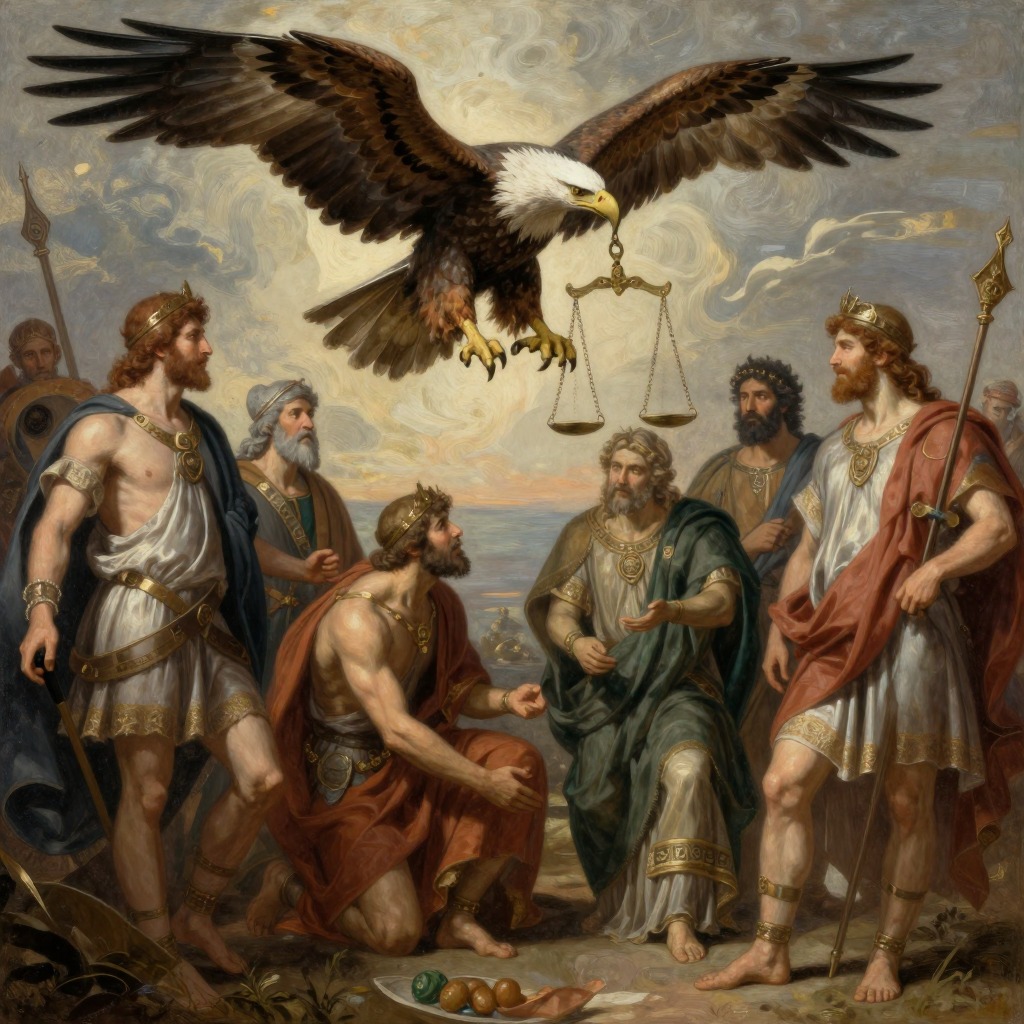
The most sustained and complex treatment of Justice occurs in the Heaven of Jupiter, where the souls of just rulers form the shape of a giant Eagle. This Eagle speaks with a single voice, declaring, "Being just and merciful / Am I exalted here unto that glory / Which cannot be exceeded by desire" (E12365-E12367). The Eagle then addresses the central theological problem of salvation: how can a just God condemn a virtuous man born on the banks of the Indus who has never heard of Christ? The Eagle's answer is a profound assertion of the limits of human reason. It states that the divine will is the very definition of the good: "The primal will, that in itself is good, / Ne'er from itself, the Good Supreme, has moved. / So much is just as is accordant with it" (E12438-E12440). Human judgment, which sees only a small part of the divine plan, cannot comprehend the full scope of God's justice. The Eagle then forms the letters of the opening of the Book of Wisdom, "DILIGITE IUSTITIAM QUI IUDICATIS TERRAM" ("Love justice, you who judge the earth") (E12306-E12308), a direct command to earthly rulers to govern righteously. The Eagle's eye is composed of the most righteous souls, including King David, Emperor Trajan, and the Trojan Ripheus, the last of whom was saved by his perfect love of righteousness before the coming of Christ, a testament to the mysterious workings of grace (E12568-E12570).
Justice as the Harmony of the Saved
In the Empyrean, the final and highest heaven, Justice is no longer a punitive or even a corrective force but the very condition of blessedness. Piccarda Donati explains to Dante that the souls in Paradise have no desire for a higher place because their will is perfectly aligned with God's. She states, "Brother, our will is quieted by virtue / Of charity, that makes us wish alone / For what we have, nor gives us thirst for more" (E10122-E10124). This culminates in the famous line, "And his will is our peace" . Here, Justice is not an external imposition but an internal reality: the soul's complete acceptance of its place in the divine order is the essence of its joy. The entire hierarchy of Paradise, from the lowest sphere to the highest, is a manifestation of this just and peaceful order, where each soul receives exactly the measure of grace it is capable of enjoying, and all are perfectly content. The final vision of God, where Dante sees the threefold circle of the Trinity and the human form within it, is the ultimate revelation of a universe held together by the love that is also perfect justice.